



SEO article
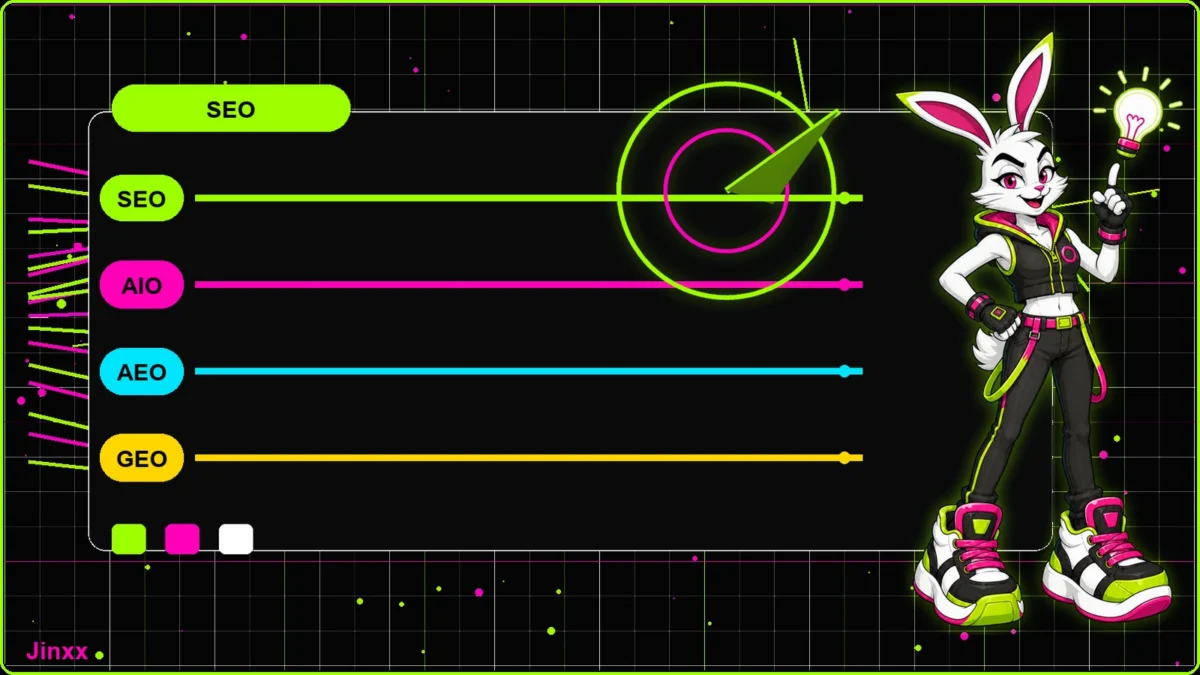
SEO vs AIO vs AEO vs GEO
SEO vs AIO vs AEO vs GEO is the new visibility question for businesses that want to be found online. SEO vs AIO vs AEO vs GEO is not just a set of acronyms. It describes how people discover answers across Google search results, AI overviews, answer engines, and generative search tools. SEO vs AIO vs AEO vs GEO matters because ranking on a traditional results page is no longer the only way a customer may find, compare, or trust a business.
The simple answer is this: SEO helps pages rank in search engines, AIO helps content appear in AI overview-style summaries, AEO helps content answer direct questions, and GEO helps brands become visible inside generative AI responses. Understanding SEO vs AIO vs AEO vs GEO helps a business build content that can be found in more than one discovery environment.
Visibility compass
Jinxx with a four-direction compass for SEO, AIO, AEO, and GEO.
What SEO Means
SEO stands for search engine optimisation. It focuses on helping pages rank in search results for relevant keywords and keyphrases.
Good SEO includes technical crawlability, strong page structure, clear headings, useful content, internal links, metadata, backlinks, and search intent. SEO is still the foundation because search engines need to understand what a page is about before they can rank it.
For blog content, SEO means choosing the right keyphrase, using one clear H1, matching the slug to the keyphrase, answering the search quickly, and supporting the article with related headings.
What AIO Means
AIO stands for AI optimisation. In practical terms, it means shaping content so it can be understood, summarised, and selected by AI-driven search features.
AI overview-style results tend to favour content that is clear, structured, direct, and useful. Long vague introductions do not help. AIO content should define terms, answer the main question early, use clean sections, and make relationships between ideas obvious.
The goal is not to trick AI. The goal is to make the content easy for AI systems to interpret accurately.
What AEO Means
AEO stands for answer engine optimisation. It focuses on giving concise, high-quality answers to specific questions.
AEO is useful for searches that start with words like what, why, how, when, which, and best. It also supports FAQ sections, featured snippets, voice-style answers, and direct response formats.
For example, a heading like "What is an AI marketing platform?" should be followed by a direct answer before expanding into detail. The answer should be useful even if the reader only reads one paragraph.
What GEO Means
GEO stands for generative engine optimisation. It focuses on how brands, topics, and entities appear in generative AI tools.
GEO is about authority, clarity, consistency, and association. A business needs to be connected with the problems it solves, the category it belongs to, and the language customers use when asking AI tools for recommendations or explanations.
This makes entity signals, original positioning, useful definitions, and consistent topical coverage more important.
How They Work Together
The strongest strategy does not choose one acronym and ignore the others. SEO gives the content a search foundation. AIO helps AI summarise it. AEO makes the answer clear. GEO strengthens the brand's presence inside generative discovery.
This is where Jinxx can help. Jinxx approaches marketing visibility as a connected system, not a pile of separate tactics. The point is to build pages and articles that work for search engines, AI summaries, answer engines, and generative tools without losing the human reader.
The Bottom Line
SEO vs AIO vs AEO vs GEO is really about modern findability. Search is changing, but the goal is still simple: help the right people find the right answer at the right time.
Businesses that structure content clearly, answer questions directly, and build consistent topical authority will have a better chance of being discovered wherever the next search happens.
Campaigns, not chaos.
Jinxx helps turn brand signal, search intent, and content workflow into marketing that actually moves.